Coffee stays hot longer in a closed, vacuum-insulated travel mug than in an uninsulated cup, but there is no single duration that applies to every mug. Insulation, lid design, starting temperature, and how often you sip determine when your coffee stops feeling hot. Choose by construction and your drinking routine, not by a heat-retention claim alone.
- How long does coffee stay hot in a travel mug? Vacuum insulation and a closed lid matter more than stainless steel alone.
- Brew4ufresh serves home coffee drinkers shopping for coffee and drinkware; check each mug’s construction before comparing heat retention.
- Preheat your mug, follow its fill guidance, and close the lid between sips to reduce heat loss.
- Test your usual coffee at your usual drinking time; a sealed-mug claim does not describe every commute.
Why this matters
A mug can keep coffee warmer than an open cup without keeping it at the temperature you enjoy. Your first sip and your last sip are different requirements. Buying only for maximum heat retention can also leave you waiting for coffee to cool.
For your 2026 mug purchase, separate the material from the insulation system. Stainless steel describes the vessel’s material; vacuum insulation describes how the walls limit heat transfer. The ceramic versus stainless steel travel mug comparison explains another distinction to consider before choosing.
How long does coffee stay hot in a travel mug?
Coffee stays hot until heat loss brings it below your preferred drinking temperature. That point depends on both the mug and your use, so an hour-based claim is meaningful only when its test conditions match your routine.
Compare the construction first. These categories describe different approaches to retaining heat, not guaranteed holding times.
| Mug construction | Best for | Main benefit | Main limitation |
|---|---|---|---|
| Vacuum-insulated travel mug with a closing lid | Carrying coffee while delaying cooling | Limits heat transfer through the walls and reduces exposure at the opening | Coffee can remain too hot for an immediate sip; the lid still loses heat |
| Non-vacuum double-wall travel mug | Drinking while adding some separation between the coffee and outer wall | Provides an insulating space between the walls | Double-wall construction alone does not establish vacuum-level heat retention |
| Single-wall mug with a lid | Drinking soon after pouring | A lid reduces exposure compared with an uncovered cup | The wall still transfers heat readily; material alone does not provide insulation |
| Open ceramic mug | Drinking at a desk without a lid | Gives easy access and lets coffee cool for drinking | The exposed surface allows heat loss and evaporation |
A useful comparison states the starting temperature, fill amount, room conditions, lid position, and endpoint temperature. Without those details, two advertised durations can describe different tests rather than different levels of performance.
Your own result also changes as you drink. A nearly empty mug contains less hot coffee than a full one, so the remaining drink has less stored heat. The same mug will not behave identically throughout your morning.
Vacuum-insulated mugs: best for slowing heat loss
Vacuum insulation reduces heat transfer across the space between the mug’s walls. It does not stop every route out. Heat still moves through connected components, including the neck and lid, and escapes when you open the mug.
Choose vacuum insulation when keeping coffee hot is the main requirement. Confirm that the product description explicitly identifies the construction rather than assuming that a stainless steel body or thick wall provides it.
The trade-off is slower cooling when you want to drink immediately. If fresh coffee feels too hot, let it reach a comfortable temperature before sealing the mug. Do not use your first large sip as a temperature check.
Non-vacuum mugs: best for drinking sooner
A non-vacuum mug is not automatically a poor choice. If you pour coffee and drink it soon afterward, slower cooling is not necessarily your priority. A comfortable handle, easy cleaning, and a suitable opening can matter more.
The limitation is that a lid and a double wall do not establish a particular holding time. Choose a non-vacuum mug for its fit with your routine, not for an assumed insulation rating.
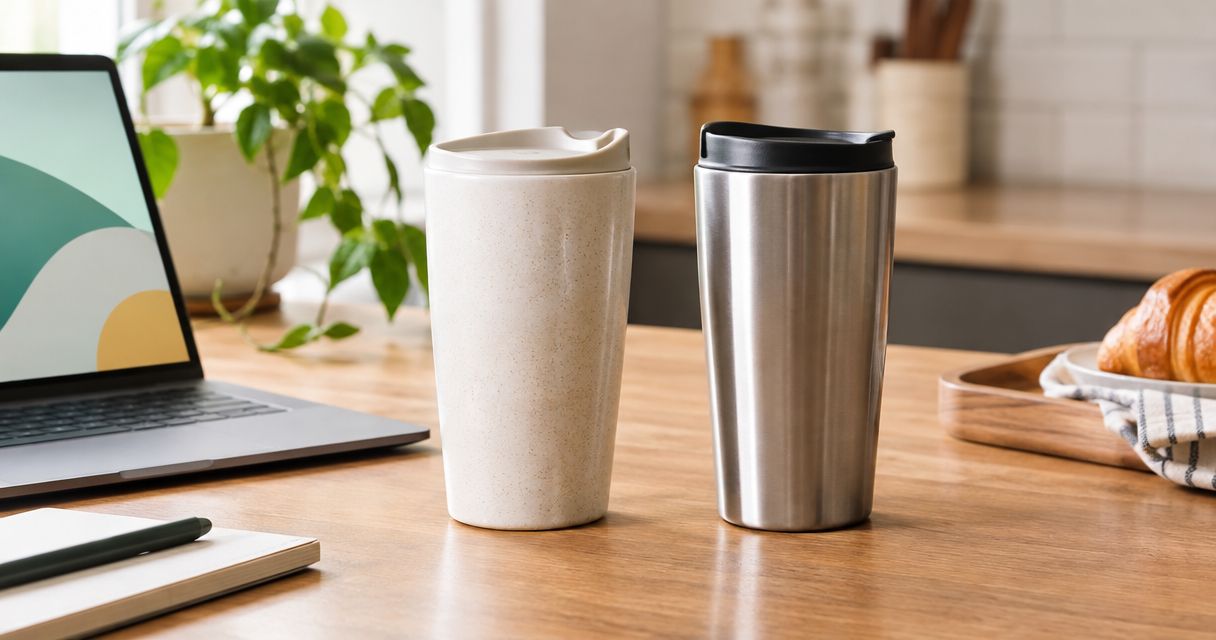
This distinction matters when comparing metal and ceramic drinkware in 2026. Compare the complete design, including the lid, instead of treating the material name as a performance guarantee.
Why coffee heat retention varies
These factors explain why the same travel mug can produce different results from one morning to the next:
- Insulation: Vacuum construction limits heat transfer through the walls. A single-wall vessel lacks that insulating barrier.
- Lid design: A closed opening reduces exposure. An uncovered drinking slot gives heat and water vapor a path out.
- Starting temperature: Hotter coffee begins with more heat to lose before reaching your preferred drinking temperature.
- Fill amount: More coffee stores more heat than a small remaining portion, assuming the same starting temperature.
- Opening frequency: Removing the lid or leaving the opening exposed increases opportunities for heat loss.
- Surroundings: Cold air and airflow increase heat transfer compared with still, warmer surroundings.
Milk or creamer also changes the starting point when you add it cold. That does not mean the mug suddenly performs worse. It means the coffee enters the holding period at a lower temperature.
Separate these effects before blaming the vessel. A different fill amount, an open lid, or a cold addition can explain a cooler drink without any change to the insulation.
How can you keep coffee hot longer in a travel mug?
Use the following sequence for your 2026 morning routine. Follow the mug manufacturer’s instructions whenever they specify handling, filling, or cleaning requirements.
- Preheat. If the mug’s care instructions permit it, warm the interior with hot water before adding coffee. Empty that water before filling.
- Fill correctly. Add your coffee while respecting the manufacturer’s fill line and required space beneath the lid. Never overfill to chase longer heat retention.
- Close the lid. Seat the lid properly and close the drinking opening when you are not sipping. Check that any removable seal is correctly positioned.
- Keep it closed. Avoid repeatedly removing the entire lid. Open only what you need for drinking, then close it again.
- Clean thoroughly. Remove coffee residue from the lid and clean accessible seals according to the care instructions. Reassemble everything correctly before use.
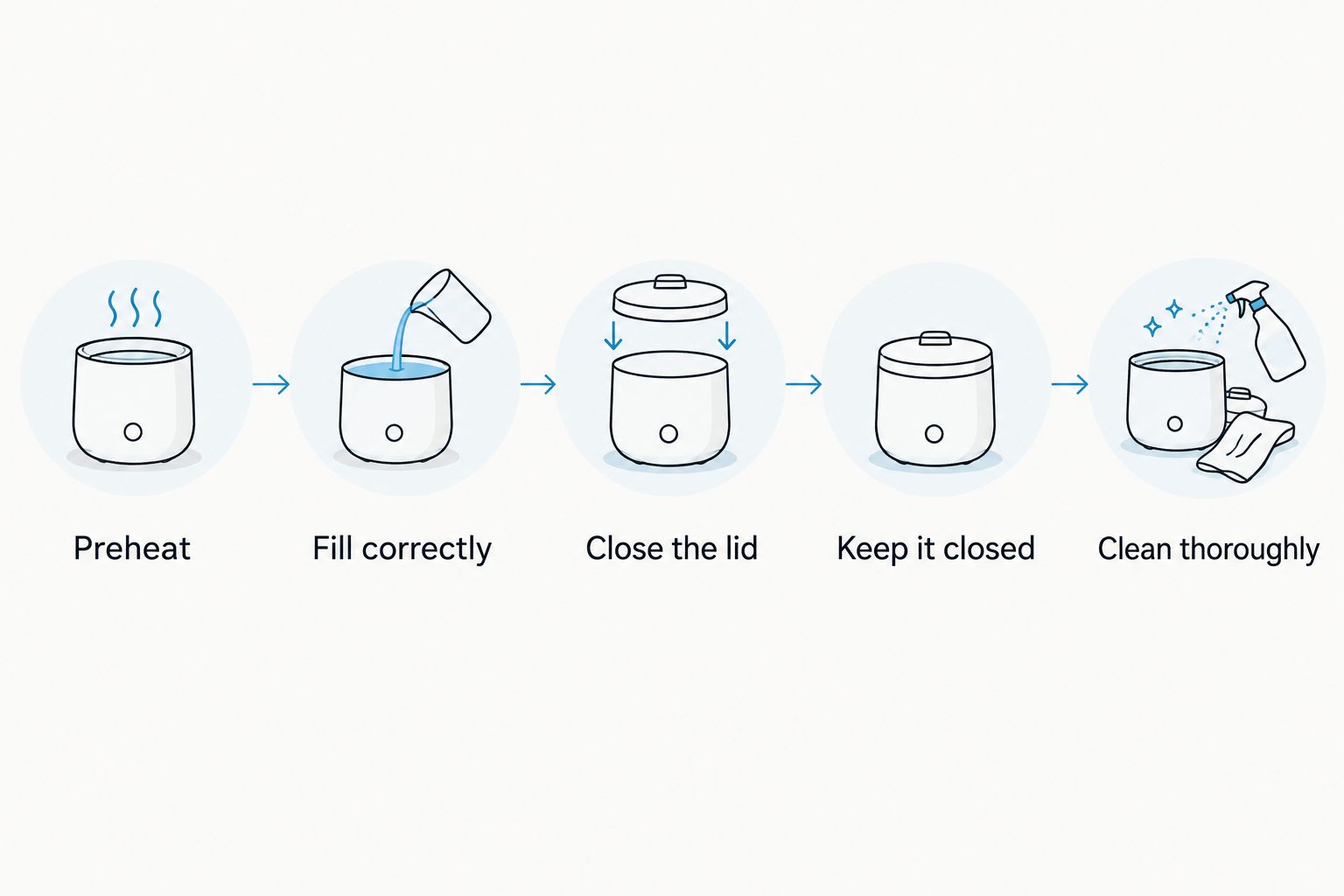
Preheating helps because the mug itself otherwise absorbs heat from the coffee. It does not turn an uninsulated vessel into a vacuum-insulated one. Think of it as reducing an initial loss, not adding a new insulation system.
Keep transport safety separate from temperature retention. A lid that closes for sipping is not automatically suitable for carrying sideways in a bag. Check the stated handling instructions instead of assuming that heat retention also means leak protection.
How do you test your travel mug at home?
Test the mug against your actual drinking schedule, not an imagined all-day requirement. A repeatable check tells you whether it suits your commute, desk routine, or first break.
For a practical 2026 comparison, use a food thermometer and record these checkpoints. The intervals below are a suggested test schedule, not predicted heat-retention results.
| Checkpoint | What to record | Why it helps |
|---|---|---|
| At filling | Starting temperature and fill amount | Establishes a consistent baseline |
| After 30 minutes | Coffee temperature and lid-opening history | Checks an early drinking point |
| After 60 minutes | Coffee temperature and amount remaining | Checks a later point while accounting for drinking |
| After 90 minutes | Coffee temperature and whether you still enjoy it | Checks whether the mug suits a longer routine |
Use the same coffee amount, starting temperature, and surroundings when comparing mugs. Otherwise, the result mixes construction differences with preparation differences.
For a realistic trial, sip as you normally would. For a controlled comparison, keep both mugs closed between measurements. Do not compare one sealed mug with another that you drink from throughout the test.
Measure only when needed, because opening the mug changes the conditions. Record your comfort separately from the thermometer reading. Your preferred drinking temperature is a personal endpoint, not a universal product specification.
Does opening the lid make coffee cool faster?
Opening the lid increases heat loss by exposing hot coffee to the surrounding air. Removing the entire lid creates more exposure than briefly opening a small drinking port, though the actual difference depends on the designs.
Close the opening between sips when heat retention matters. If you deliberately want the coffee to cool, set the mug securely on a stable surface before opening it.
Does a larger travel mug keep coffee hot longer?
A larger amount of coffee stores more heat, but a larger mug does not automatically outperform a smaller one. Insulation, shape, lid design, and starting temperature still affect the result.
Compare mugs at the fill amounts you actually use. An oversized mug holding a small serving is a different situation from a full mug, even when the vessel is identical.
Does coffee stay hot longer without milk?
Coffee starts cooler when you add milk that is colder than the coffee. That lowers its temperature before the mug’s holding period begins; it does not prove that the insulation is weaker.
For a fair comparison, prepare both drinks the same way. If you normally add milk at home, include it before recording the starting temperature.
What should you check before buying in 2026?
Start with the time between pouring and drinking. Then check construction, lid operation, cleaning access, and whether the mug fits where you intend to carry or place it. A heat-retention headline cannot answer those questions.
Brew4ufresh lists the 25 oz & 40 oz Stainless Travel Mug among its drinkware. Those capacity options and the stainless steel material do not, by themselves, establish a verified holding time. Check the product’s current construction details and care instructions before treating it as a long-hold option.
Brew4ufresh is best for home coffee drinkers who want coffee and drinkware from one store. For any travel mug, the same buying rule applies: confirm the feature that matters rather than inferring it from the product name.
Use this final screen before deciding:
- Choose explicitly stated vacuum insulation when delaying cooling is your priority.
- Choose a drinking opening you can operate comfortably and close between sips.
- Check whether the lid and seals are accessible for cleaning.
- Confirm fit and handling requirements from the actual product details.
- Treat temperature retention and spill protection as separate features.
FAQ
How long does coffee stay hot in a travel mug with a lid?
A lid helps coffee stay hot by reducing exposure, but it does not establish a fixed holding time. Insulation, starting temperature, fill amount, and opening frequency determine the result.
Does stainless steel keep coffee hot longer than ceramic?
Stainless steel alone does not establish better heat retention than ceramic. Compare insulation and lid construction rather than material names alone.
Should I preheat my travel mug before adding coffee?
Preheating reduces the heat that the mug initially absorbs from your coffee. Use hot water only if the mug’s care instructions permit it, then empty the water before filling.
Why is my coffee cooling quickly in an insulated mug?
An open drinking port, a lower starting temperature, or a small remaining serving can explain faster cooling. Check lid assembly and seals as well as how you prepare and drink the coffee.
Can I put my travel mug in the microwave to reheat coffee?
Do not microwave a stainless steel travel mug. For other materials, follow the manufacturer’s microwave instructions, including any separate restrictions for the lid.
Does keeping coffee hot mean it is safe to drink all day?
Heat retention is not a food-safety guarantee. Follow food-safety guidance for perishable additions such as milk, and do not use warmth, smell, or taste as proof of safety.
How can I compare travel mugs without relying on advertised hours?
Compare mugs using the same starting temperature, coffee amount, lid-opening pattern, and surroundings. Check the temperature at your normal drinking time and record whether it suits you.
One last thing
The best heat-retention target is your next drinking moment, not the longest claim on the shelf. A mug that leaves your coffee comfortably hot when you want it is more useful than one that keeps it too hot until your break is over.
Before replacing your current mug, try preheating it and closing the drinking port between sips. Repeat your normal routine with those changes. You will have a clearer reason to keep it or choose a different construction.